Five trends from EdTech Week, and what they mean for school leaders
November 3, 2026

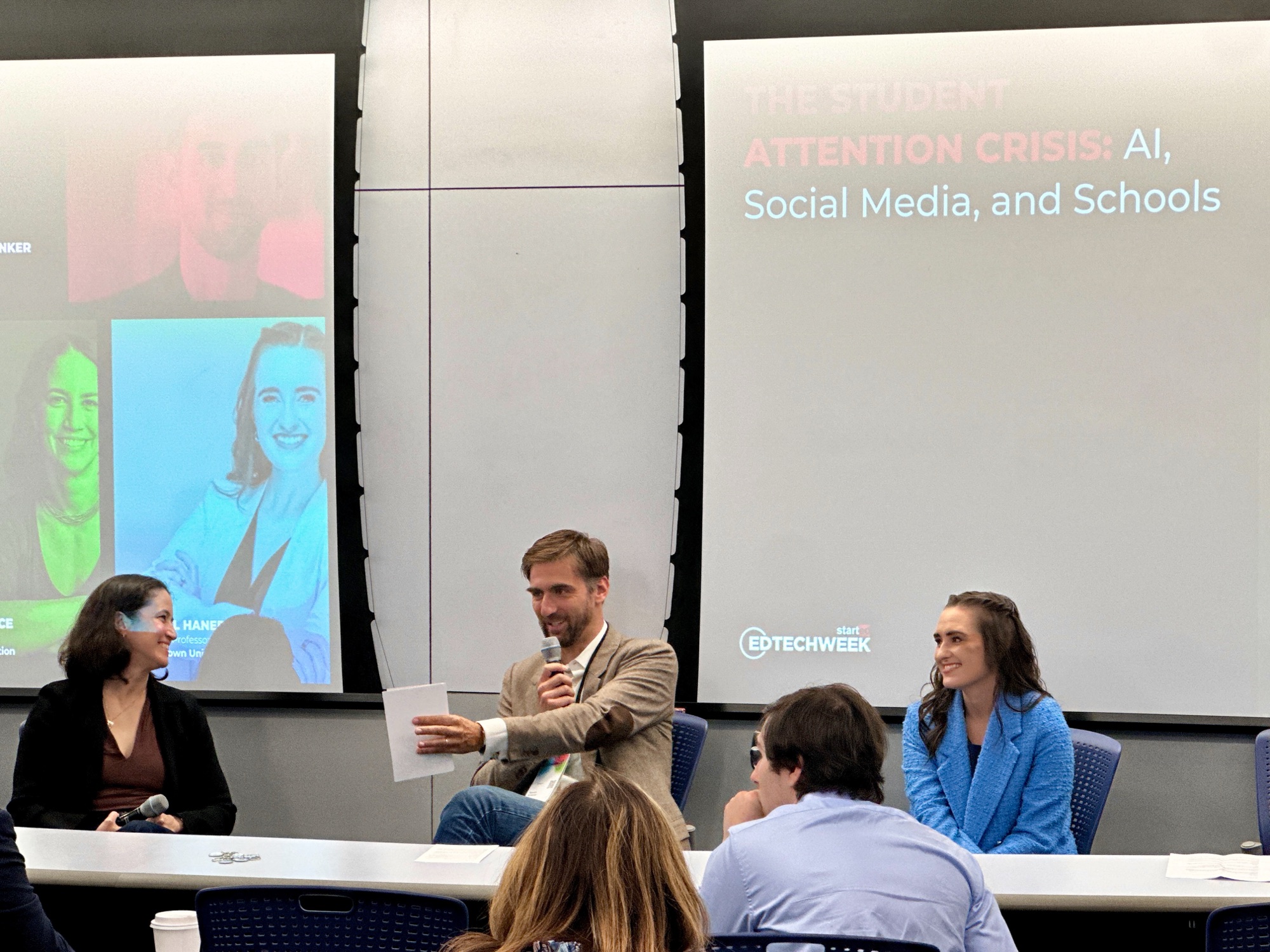
Schools are fighting on two fronts at once. Phones are leaving classrooms and AI is arriving, usually with little evidence of what either does to kids. At EdTech Week at Columbia University’s Teachers College, I dug into it with two experts:


Our conversation centered on one question: can schools teach kids to use technology well, instead of just keeping it out of their hands? The answer looks very different for a second grader than for a high school junior or a college freshman. But one idea came up repeatedly: schools have a responsibility to help students build the skills to use technology thoughtfully and independently.
For roughly a decade, schools assumed more screens meant better learning. Many educators no longer accept that premise, and they’re now asking vendors a question they rarely had to answer before: Is this better than the analog version?
Catherine captured the shift. A new drug needs years of testing before it reaches the public, she said, “but we’re rolling out powerful products to our children with no testing or accountability at all.”
She isn’t entirely anti-tech. As a middle school teacher, she once used a computer game to teach multiplication. But she’s pushing schools toward frameworks like Every School’s EdTech Triangle, “the food pyramid, but for tech.” Analog is the default, and technology has to earn its way up. Does an 8-year-old need Google Maps, or would a globe work better?
The pendulum can swing too far, though. Rachel warned that if schools strip tech out without teaching kids to use it, she’ll spend years in her college classroom helping them catch up.
What’s next: Engagement is no longer a selling point. The edtech products that win will be the ones that can show evidence of learning, fit the developmental stage of the kids using them, and make a clear case for why they beat pencil and paper.
Phone-free school policies used to be rare, and now they’re much more common. Catherine is careful about how she talks about them: “I wouldn’t talk about it as a ban. That has a negative connotation, whereas the effects are extremely positive. Instead of talking about ‘phone bans,’ I refer to these as ‘phone-free policies.’”
But a new gap is emerging. A phone-free day protects kids’ attention for seven hours, and then the bell rings. Rachel, who works with adolescents, pointed out that teens are still developing self-control. Asking them to beat products engineered for attention on willpower alone isn’t a fair fight. And when rules are made without their input, teens tend to feel powerless, which makes it less likely the habits stick once the rule is gone.
She compared it to driving. We wouldn’t keep a teenager off the road until 18 and then hand over the keys with no lessons.
What’s next: Especially in middle and high school, expect schools to pair phone-free policies with programs and tools that help students manage their own attention, building skills that last well beyond the school day.
The cheating problem is real. A 14-year-old told Catherine that her classmates knew they could use AI as a tutor. “But we have so much homework,” she said, “we just find it’s easier to use it to cheat.”
Rachel’s approach is to teach AI the way you’d teach driver’s ed. Before you get behind the wheel, you learn the rules of the road and where the blind spots are. AI has blind spots too. It invents facts, it reflects bias, and the companies behind it have their own incentives.
In her college classroom, students helped write the AI policy, and every assignment says up front whether AI is allowed. She also has them compare their own work with AI’s. In one exercise, students write an email to a business owner on their own, then write it again with ChatGPT. Afterward they talk through what the AI did better, what it missed, and what they got out of doing it themselves.
What’s next: This approach is best suited to high school and college students. For younger children, both Catherine and Rachel urged considerably more caution. The emerging consensus is that AI literacy should be staged by age, not one-size-fits-all.
Every student now has a magic wand that can write the essay or solve the problem in seconds. That changes what school is for. The effort AI lets kids skip, like building an argument or working through a hard problem, is often the learning itself. The skill that matters now is knowing when to use the wand and how to evaluate what it produces.
Sometimes good judgment means not using it at all. Rachel told the story of a teenager who asked her mom for help with math homework. Wanting to give her a good answer, the mom opened ChatGPT. But the teen could have done that herself. What she wanted was her mom.
What’s next: As AI makes polished output effortless, schools will need to place more weight on process, reasoning, and human connection, and less on the finished product.
The push for change is coming from kids. Through the nonprofit Half the Story, New York students got small grants to design phone-free experiences. They asked for scavenger hunts and screen-free dances, including a prom with a photographer, a photo booth, and games.
Similarly, Catherine recently ran a university-wide “Phone Breakup Challenge” for NYU’s IRL initiative, and found that students were hungry for hands-on activities such as crafts, and opportunities to meet and interact with other students in person.
We see the same student demand at Opal. About 75% of our users are high school and college students, and many sign up on their own.
Getting kids offline also means adults have to tolerate a bit more risk. Rachel noted that some malls now bar unaccompanied minors after 3 p.m. Catherine pointed to Jonathan Haidt’s argument that we overprotect kids in the real world and underprotect them online. A kid on a phone in their bedroom seems safe. A kid at the park seems risky.
What’s next: Students are ready. What’s often missing is adult support and funding for offline activities, which may prove a smarter investment than another round of devices.
Phones or no phones, AI or no AI, the bigger goal is attention health: the ability to focus, think independently, and decide when to turn to technology and when to step away from it. Phone-free schools give students a strong start. The next step is helping them build the skills so they eventually don’t need the rules.
That’s the future we’re building Opal for. In part two, we’ll share a practical playbook to help schools put these ideas into practice. If your school is rethinking its phone policy, let’s talk.